“For we are his workmanship, created in Christ Jesus for good works, which God prepared beforehand, that we should walk in them.” Ephesians 2:10
In his letters to churches, Paul often begins with a theological discussion and concludes with exhortations for living out the implications of that theology. Ephesians is no different. Throughout this Prison Epistle, Paul repeatedly discusses what he calls the Christian’s “walk.” Ephesians 2:10 contains one of the key pieces necessary to understanding this concept. This exegesis exercise begins with a general overview of the book of Ephesians, then situates the verse in its immediate context in Chapter 2, and ends by looking at Ephesians 2:10 itself.
In Ephesians, Paul takes readers on a journey to the heights of heaven. There, Christ is seated above all and yet still concerned with how Christians live life in a sinful world dominated by “the prince of the power of the air” (2:2). Throughout his text, Paul calls these nitty-gritty aspects of right living “our walk” (2:2, 10; 4:1, 17; 5:2, 8, 15). He writes so the Ephesians can know and understand the majestic works that God the Father has accomplished through Jesus Christ: his cross, resurrection, and ascension for sinners’ redemption and reconciliation with God. Each one of these events grounds our Christian walk in the Father’s deeds in Christ. In his sovereignty, God planned all this before the foundation of the world (1:4), to the praise of his glory (1:6, 12, 14).
Chapter 2 begins with “and you being dead in your trespasses and sins” (author’s translation). This “and” connects chapter 2 with what came before: chapter 1’s discussion of the power of God to raise Christ from the dead and seat him in the heavenly places (1:19–20). “You being dead” is a participial phrase in the accusative case: It functions as the object of the verb. That verb doesn’t come until verse 5: “He made us alive” together with Christ. This break and restart in the grammatical flow of the sentence is called an anacoluthon. Paul’s very long sentence could be simplified like this: God (subject) makes alive (verb) those who were dead (object).
In verse 2–3, Paul paints a detailed portrait of humans. We are described as children of wrath who are living in sin and under the influence of the devil, resulting in our judgment and death. Verse 4 marks a turning point in this paragraph: “But God.” In verses 4–7, Paul presents what God has done for the spiritual “walking dead” of verse 1–3, all in aorist verbs, the Greek simple past tense. God made us alive. He raised and seated Christ and those in Christ “with him in the heavenly places” (2:5–6). The past tense indicates the fact that these acts are finished. We are no longer dead!
2:8–10 then explains that, because of God’s grace and through our faith in Christ, we are saved and created anew. Notice that Paul uses the passive voice: we have “been saved” and “been created.” God has done the saving and the creating, not us. Believers now enjoy a new status: alive in Christ. In 2:8, Paul uses a linguistic technique called foregrounding: moving a word to the beginning of the sentence to increase its prominence. By foregrounding “grace,” Paul’s wording functions like a bright yellow highlighter emphasizing the most significant part of his thought: God’s grace is the reason he saves us.
We’ve now mapped out Ephesians 2:1–9. In essence:
- We were spiritually dead in our sin, headed for God’s wrath. (2:1–3)
- But in Christ, God made us alive. (2:4–7)
- Because of God’s grace, we are saved and created new. (2:8–9)
Ephesians 2:10 comes at the end of the first paragraph of chapter 2: “For we are his workmanship, created in Christ Jesus for good works, which God prepared beforehand, that we should walk in them.” In English, verses 8 and 10 both begin with “for,” gar in Greek. In each case, the “for” introduces an explanation of the sentence before it. We cannot boast in our works (v. 9) because we are God’s workmanship (v. 10). Paul again uses foregrounding here, moving the possessive pronoun forward to read something like “HIS workmanship (poema) we are.” Some versions translate poema as “masterpiece” (NLT), but I respectfully posit that this is an overinterpretation. From the verb poieo, “to do or make,” a poema is a thing that has been made. Certainly, because of the nature of God, his work is masterful, but poema itself simply refers to something made. I suggest we stay with “workmanship” and its connotations of craft and intentionality. We were dead in our trespasses and sins, and God gives us new life in Christ: This act makes us his workmanship.
Paul has been hinting at creation themes throughout this paragraph, and now in 2:10b, he explicitly refers to believers as having been created (ktizo) in Christ Jesus. In the Hebrew Bible, both humans and God can “make” (‘asah, LXX poieo); however, in the Old Testament, only God is the subject of the verb “to create” (Hebrew: bara’; LXX ktizo). This exclusive ability pairs well with this passage’s teaching about our salvation: We are saved by grace through faith, not because of ourselves, and not from our works (2:8–9). Only God can create, so only God can create new creatures.
This new creation takes place “in Christ.” In Ephesians, Paul uses the expression “through” Christ to convey that God’s redemption and reconciliation come by means of Jesus and his work on the cross (1:7; 2:16). However, here in verse 10 and in 2:6–7, “in Christ Jesus” refers to place, the location or sphere in which God performs this new creation. Similarly, in the Old Testament, God often saves his people when they are in the right place: in Noah’s ark, in a home marked with the blood of the Passover lamb, on the wisdom path. The same is true in this verse in Ephesians: Salvation takes place when the believer is in Christ Jesus.
Paul continues, developing our understanding of “in Christ Jesus.” Paul has been using the preposition syn, “with,” prefixed to several verbs in the preceding verses. Believers are made alive together with Christ (synzoopoieo, 2:5), raised together with Christ (synegeiro, 2:6), and seated together with Christ (synkatizo, 2:6). While being in Christ is not the same as being with Christ, the two are related. Because believers are in Christ, we go where he goes. He dies; we die. He is raised; we are raised. He is seated in the heavenlies; we are seated there, too (see Eph. 1:20; Col. 2:12; 2 Tim. 2:11).
Our new life, God’s grace gift to us, comes with a purpose: to do good works. Verses 8–9 carefully explain that we are not saved because of ourselves or our works. Instead, we have been created anew unto good works, with the charge to do good works. These works are the result, not the cause, of our new life in Christ.
Paul adds one more concept to these good works: God prepared them for us beforehand (proetoimazo). Paul uses this idea of “before” (pro) in other places in Ephesians: God chose us in Christ before (pro) the foundation of the world (1:4), and he predestined/foreordained (proorizo) us to adoption and according to his purpose (1:5, 11). Our new life’s purpose is to do the works that accomplish God’s purpose. These good works are waiting for us; God has laid them out already.
Paul begins Ephesians by discussing our deadness in Adam and how we “walked according to the course of the world” (2:2). God has given us new life, a gift of his grace. He charges us to do the good works prepared for us; this is how we, his new creatures, walk worthy of our calling (4:1), not according to the futility of our mind (4:17), but walk in love (5:2), walk as children of Light (5:8), and walk as wise not unwise (5:15). Ephesians 2:10 links Paul’s theological argument to his practical teaching to come in his letter.
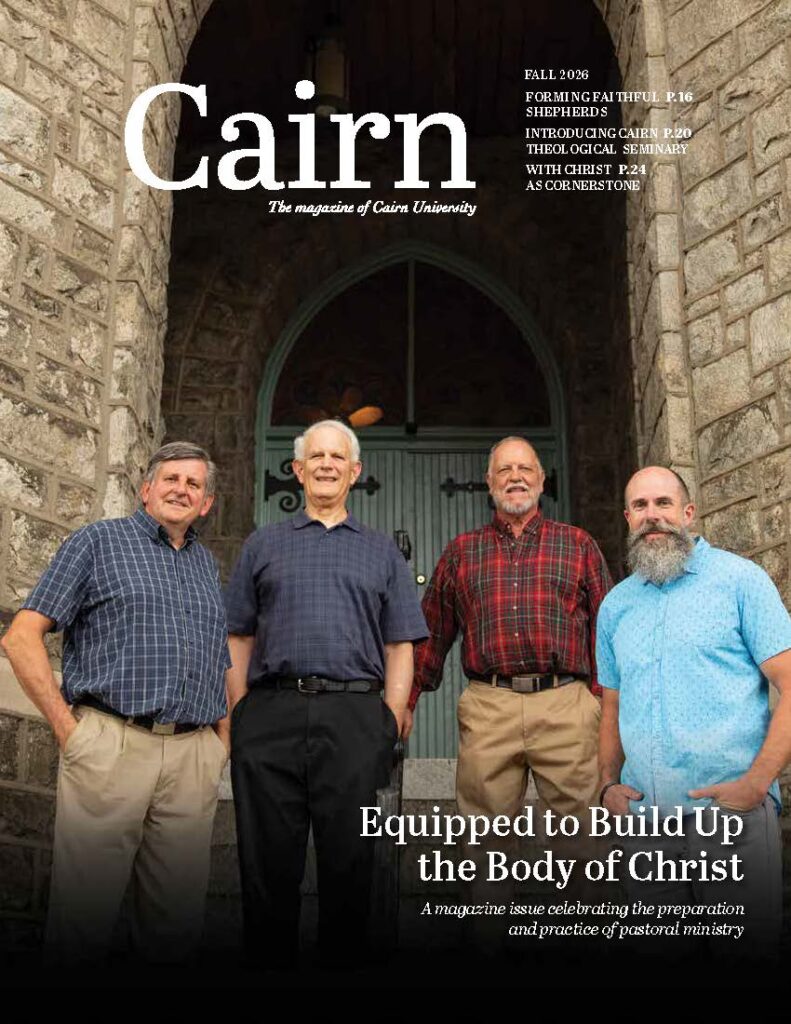
The article was originally published in the Fall 2026 issue of Cairn magazine.