It has been 20 years since the current mission statement was approved by the Board of Trustees. In 2005, President Sherrill Babb charged me as provost to propose a revision to our existing mission statement that might better reflect our core commitments and expanding vision as a biblical university.
Our academic programs under Dr. Babb’s leadership had expanded beyond preparation for vocational ministry.
Our curriculum and instruction had taken on a distinctive and intentional biblical integration across all disciplines
over the course of many decades of good work by very capable academic leaders and faculty members. The social and cultural context in which we were operating had also become even more secularized. Worldly ideologies rooted in some very destructive philosophical commitments, such as subjectivism, relativism, and deconstructionism, were growing in popularity. These ideologies were positioned to shape not just the
intellect of college students, but their sensibilities and character. It was in this institutional and cultural context that we set about the work of writing a new mission statement.
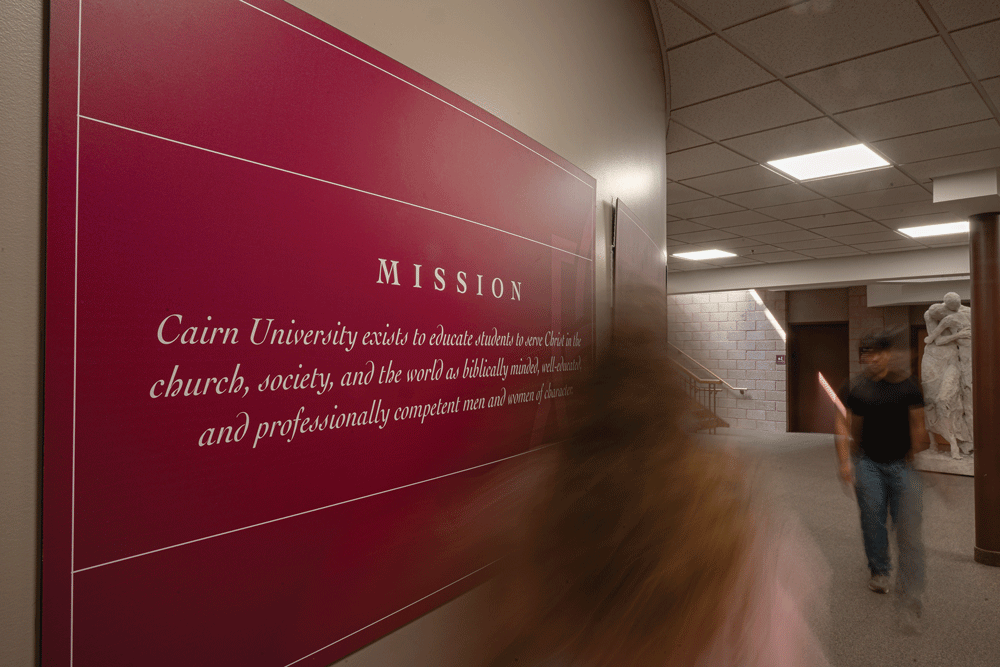
The statement was approved a year later in 2006. It reads: “Cairn University exists to educate students to
serve Christ in the church, society, and the world as biblically minded, well-educated, and professionally competent men and women of character.” Every word, every clause, every piece of punctuation was carefully selected.
We state that we exist to educate students. Christians should not shy away from that word. Discipleship is education. Education is a form of discipleship. But we do not educate students for some light or transient
purpose. We educate students to serve Christ. Life is to be lived with purpose and for a purpose. No matter
what we do, all is done in his service. This is the Christian way. There is no other. Our mission statement is
unequivocally Christocentric. In him all things hold together. In him alone we find redemption, forgiveness, and the promise of eternal life. In him alone we find identity, meaning, and purpose.
And where shall they serve him? Everywhere. We educate them to serve the Lord Jesus in the church, society, and the world. This does not mean pastoral studies majors for the church, politics majors for society, and missions majors for the world. Rather, this language captures the essence of our belief that Christians serve the Lord
Jesus in all three. All of us, regardless of our vocations and stations in life, are members of the body of Christ and
are called to live the Christian life as members of that body, the Church. Whether we are pastors, elders, deacons, Sunday school teachers, or nursery workers, we are all obligated to take up our place in the church and to serve Jesus there.
All Christians also have an obligation to be good neighbors and state in which we live. God commanded the children of Israel through the prophet Jeremiah, to “seek the welfare of the city where I have sent you” (29:7).
The New Testament teaches that we are ambassadors of Christ. All of us serve the Lord Jesus by being his men and women wherever we find ourselves.
All Christians also need to understand God’s Kingdom is larger than our own personal corner of it and must appreciate what God is doing in this world. The gospel knows no ethnic, racial, or national boundaries. From its
very inception, the church set about carrying the good news of Jesus to the corners of the earth in fulfillment of the great commission.
Christians do not get to choose whether they care about the church or society or the world. Rather, we share in common the calling that we serve the Lord Jesus in every one of those settings. This is why our mission states this so plainly. And this is why we give our students opportunities to practice serving Jesus in these sectors. We want them in the church, we want them to be good neighbors and good citizens while they are studying with us, and we give them opportunities to learn about and participate in what God is doing around the world. Church involvement, community service, civics events, mission trips, and study abroad programs all serve the purpose of giving the students a comprehensive vision for serving Christ.
But it is also our purpose to prepare them to serve Christ as particular kinds of people. They are to serve Christ
as biblically minded, well-educated, and professionally competent men and women of character. Professional competence is more than a professional credential. It speaks to effectiveness, not just certification. We endeavor to instill in our students a commitment to personal and professional excellence. They develop the thinking and pragmatic skills that will serve them well in the marketplace and ministry. Our students learn to think well, communicate, solve problems, work well with others, and get things done. Our graduates are consistently
sought out because we develop this competency intentionally. Students are given opportunities through curricular content and internships as well as cocurricular activities, such as student groups, athletics, ensembles, and on-campus employment, to practice what they are learning and develop the real-world skills necessary for success. This is in keeping with the biblical admonition to do all things well as unto the Lord. Whatever we are given to do, it should be done competently and with excellence.
It is also important that students become well-educated. This is not for the purpose of academic reputation. And it certainly isn’t undertaken because the government tells us it must be done. For the biblical Christian, to be well-educated is a worshipful undertaking. The Psalmist declares, “Great are the works of the Lord studied by all who delight in them” (111:2). The work of learning about this world that God has created should move students to a greater appreciation for him as creator and sustainer of life. And the study of human endeavor in history and science, literature and philosophy, music and the arts gives us an opportunity to come to a greater appreciation for the divine image in humankind. We do not seek to see our students well-educated so that they can occupy an ivory tower or wear an honors cord. We do it because we believe the Earth and everything in it is the
Lord’s. It is just that simple.
Teaching the Bible is in our DNA. It is the reason we opened our doors in 1913. But we wanted to capture language that was more robust regarding the importance of teaching and studying it in the lives of our students. It is not enough to know the Bible. It is certainly not enough to know about the Bible. What we want is for students to be able to think according to it. We want them to be biblically minded. The issues of our day will change over the course of any lifetime. We must develop the desire and ability in our students to think biblically
about God, themselves, and this world. Romans 12 teaches that we are to be transformed by the renewing of our
mind. A renewed mind is a biblical mind. And so, we educate our students to serve Christ as biblically minded people.
We also purpose that our students would be men and women of character. The inclusion of “men and women”
instead of “individuals” was a deliberate choice. In 2005, we saw the gathering storm on the horizon regarding human sexuality and the number of Christian institutions capitulating on the truth that God created human beings in his image and likeness, male and female he created them (Gen. 1:27). This binary distinction is rooted in creation for his glory, our good, and the good of the world. We want our students to be crystal clear in their understanding that we uphold God’s design for human sex and sexuality and expect them to as well.
Finally, we want them to be men and women of character. This is the ultimate measure of our efforts to educate them as servants of Christ. It is not enough to know; it is not enough to be prepared. We purpose to see students become intentional and integrated Christians. Character is not a clever catchword. It is the culmination of our efforts in giving students an education that will shape them in every area of their lives.
The mission statement that occupies such a prominent place in this institution is more than the satisfaction of an accreditation requirement or the application of an organizational principle. The mission statement captures who we are and what we do. It keeps us focused and provides the measure against which we assess our work. At this
significant mile marker of 20 years since its adoption, we not only acknowledge this mission statement but recommit ourselves to it. The University Board of Trustees affirms it every year, as does every member of the faculty and staff, because it matters.
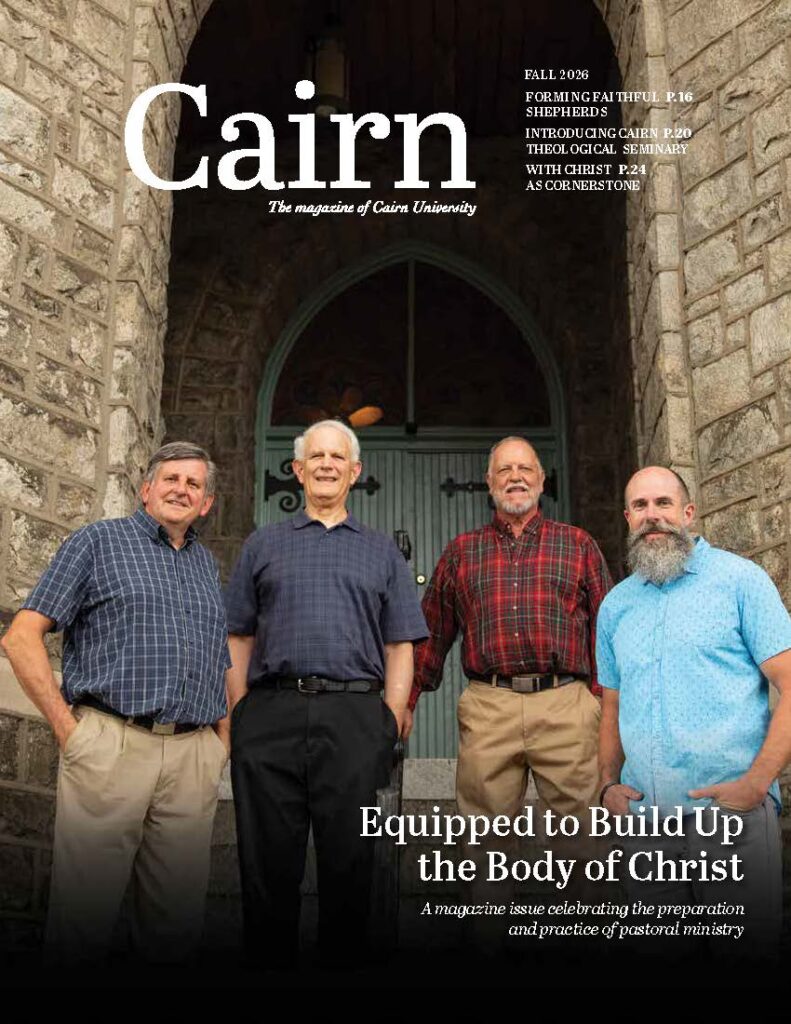
This article was originally published in the Fall 2026 issue of Cairn magazine.