Some Christians are suspicious about the value of serious academic study and spiritual vitality. We’ve all probably heard or read someone issue the warning about going off to “cemetery, I mean seminary”—as if studiousness is necessarily antithetical to vibrant spirituality. Sometimes this is linked (erroneously, I believe) to the Apostle Paul’s warning to the Corinthians that “This ‘knowledge’ puffs up, but love builds up” (1 Cor. 8:1b). But there are good biblical reasons for rejecting such a bifurcation. We are to love God with all our faculties, including our minds. The hymn writer’s prayer, “Take my intellect and use, every power as thou shalt choose,” should be the prayer of very believer, especially those charged with shepherding God’s flock. B.B. Warfield, responding to the tendency to treat study and piety as antagonistic, commented, “Sometimes we hear it said that ten minutes on your knees will give you a truer, deeper, more operative knowledge of God than ten hours over your books. ‘What!’ is the appropriate response, ‘than ten hours over your books, on your knees?’ Why should you turn from God when you turn to your books, or feel that you must turn from your books in order to turn to God?”
The very nature of biblical revelation is cause for taking biblical and theological studies for pastoral preparation seriously. While God is Scripture’s ultimate source, he sovereignly and providentially superintended human authors to record his redemptive works. Our cultural, chronological, and linguistic distance from those original writers calls for study. This isn’t to deny that we have reliable translations, commentaries, and tools at our disposal. But having some degree of facility in the biblical languages enables one to make informed decisions when they disagree. For the sake of greater ease and shorter programs, many seminaries have drastically trimmed, if not altogether eliminated study of the biblical languages, settling instead for instruction in how to use the variety of Bible language tools available. We’ve chosen not to go that route. A recent conversation with a local pastor encouraged me that there are those who appreciate that decision.
The pastor called to tell me about a young man his church wanted to bring on staff and who they wanted to get his Master of Divinity. He had taken a few courses toward it elsewhere in an online program, but he was now looking for somewhere he could study in person. Cairn was among several schools the prospective student was considering and at the top of the pastor’s list of recommendations. At the close of our conversation, he asked if the languages were required. I didn’t know the reason for the question and, to be honest, suspected that he might be looking for an easier path. But when I told him what the curriculum calls for, he replied, “Good. Because we want him to have the languages.” I added that the trend is to scale them down, to which he replied, “Then you get an inferior product,” and proceeded to encourage us to “Hold the line.” By God’s grace, we will.
And by God’s grace, we will hold the line on teaching the Bible and sound, orthodox theology, not as ends but as means of doxology, delight, and sanctification. C. H. Spurgeon was right in observing that “There is something exceedingly improving to the mind in a contemplation of the Divinity. It is a subject so vast, that all our thoughts are lost in its immensity; so deep, that our pride is drowned in its infinity.” Theology, when done properly, does not simply leave us with true knowledge of God but evokes adoration and a realization of our proper place under him and alongside each other.
When I was in the pastorate, one of my responsibilities was teaching adult Sunday School classes. (We changed the name to Adult Disciple Training to combat any idea that “Sunday School” was just for kids.) A dear older gentleman named Karl was routinely in my classes. One Sunday, he pulled me aside and told me he appreciated
how I handled questions and comments that were at best, a little off-base and at worst, far afield or outright erroneous. He said he admired my attempts to find what I could legitimately affirm in what people offered and the gracious way I offered correction when needed. Karl’s comments were encouraging. I was grateful to God for bringing forth the fruit Karl saw in me. But Karl’s words brought an array of past seminary professors to mind, for whose examples I was profoundly grateful as well. I remembered sitting in their classrooms, observing and listening to how they handled challenges, questions, and confident yet erroneous answers with grace, compassion, and wisdom. How to respond in such situations wasn’t among the objectives of their courses or topics on their syllabi. Yet, it was part of the instruction they gave me, and I was a better pastor on account of having learned from their interactions with me and others in real time. Those on the faculty of Cairn Theological Seminary are committed to being such models in the lives of our students. We want our instruction of them to consist not only of what they hear from us, but what they see in us (see Phil. 4:9).
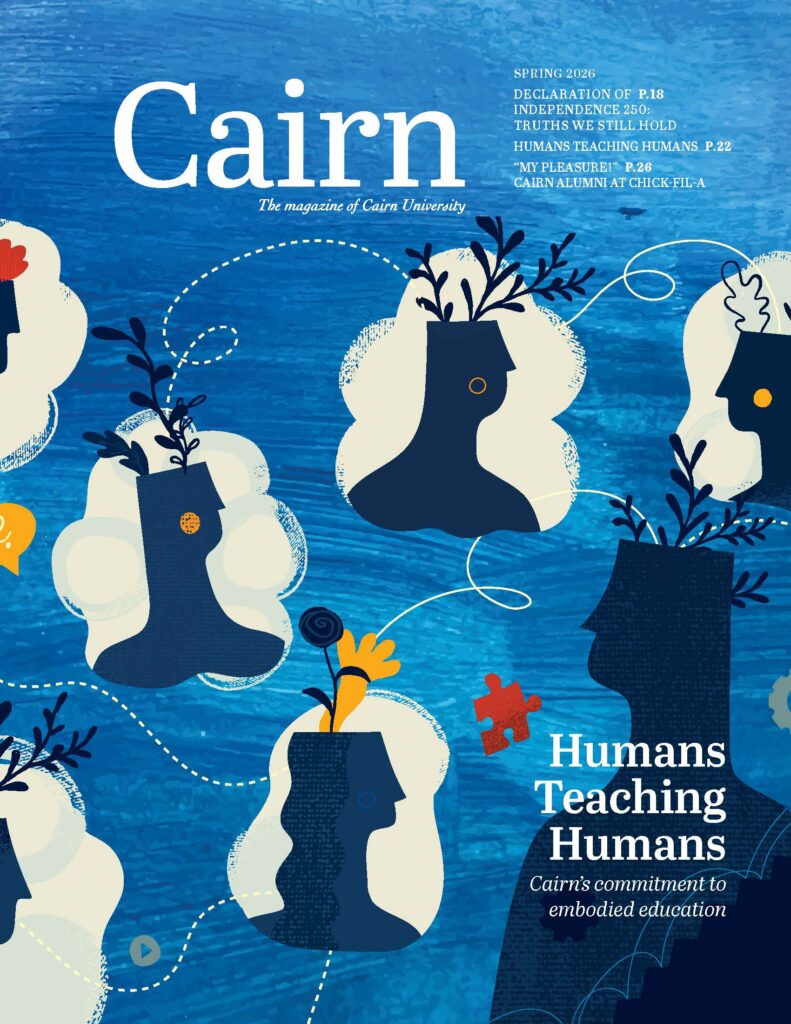
In our age of fast-paced information delivery, we can easily lose sight of the fact that Christian education, whether at the undergraduate or graduate level, is not simply a matter of data transfer. Sadly, even the voices of those who should know better are enticing current and future pastors to value speed, efficiency, and ease over the formation of their own souls and the nourishing of those in their care. And unfortunately, this is often done under the guise of making room for the “real work” of ministry. Advertisers of AI-driven products assure pastors, “We take care of the content so that you can focus on the mission,” and ask them to “imagine drafting a sermon outline in under 60 seconds.” I wish these were fabrications, but they’re not. Such marketing appeals far more to the flesh and its craving for ease and comfort than to a desire to be personally transformed by the Spirit. They dismiss what is to be gained in and through the labor of pouring and praying over the inspired texts of Scripture and engaging with saints both past and present who did the same. Formal theological study should model, encourage, and instill that kind of labor. A pastor, or anyone who teaches the Word, can think of himself in one of two ways: as a funnel or a sponge. A funnel is a conduit for getting liquid from one place to another. But it isn’t absorbent. The liquid isn’t meant to cling to it or saturate it. It’s designed to get as much liquid as possible through it to its desired location. A sponge, on the other hand, if it’s good, soaks up whatever liquid it is submerged in. And though not as efficient as a funnel, it can still be used to transfer liquid to another location by wringing it out. Pastors should be sponges, not funnels.
Yes, there is information to be communicated, pondered, and digested. There are books and articles to be read, lectures to be listened to, and conversations to be had. But to reduce Christian education to content is to forget that we are interested in the formation and transformation of our students. And we believe that this is ideally done in the context of an embodied community. Ours is an age of record loneliness, anxiety, and isolation. Teaching people how to have ordinary conversations, let alone spiritual ones, is becoming a necessary element of discipleship. This should have implications for how we train tomorrow’s ministers. If pastoring is simply a matter of knowing the right things and telling others those right things, then all that matters is content delivery. But if pastoring is a ministry of teaching and caring for souls, then attention must be paid to both content and form.
Dietrich Bonhoeffer’s classic book Life Together was born out of his commitment to training future pastors in the context of their living and learning together. In his book Bonhoeffer’s Seminary Vision, Paul House writes, “Bonhoeffer believed that seminary was a time for students to learn how to lead a faithful Christian community, and this was best learned by participation in such a community.” We don’t have the ability to go to the extent that Bonhoeffer did. But we think that especially as more of life is mediated by screens, it is vital to prepare future under-shepherds of the Chief Shepherd in the context of community.
This has intellectual and spiritual benefits. Sherry Turkle, an MIT professor who has been studying the societal effects of computers for approximately 40 years, notes in her outstanding book, Reclaiming Conversation: The Power of Talk in a Digital Age: “If you ask people who are lifelong learners where their love for learning comes from, they usually talk about an inspiring teacher. The most powerful learning takes place in relationship.” She adds, “Students watch a professor think on his or her feet, thinking aloud, and in the best cases the student can say, ‘Someday, I could do that. Someday, I could be that.’” I know that was the case for me. I recall several of my former seminary professors, whose thinking during classroom lectures and discussions I can only describe as beautiful. I have something far more than eloquence in mind. Seeing and hearing the care they took with ideas and their patient deliberation, thoughtfulness, accuracy, curiosity, and zeal for what they were talking about struck me like watching a figure skater or artist strikes many. They were apprenticing me and my classmates, not only by conveying their subject matter, but the way they did so. They stirred in me a desire to emulate them. This is the impact that our faculty members desire to have on the students we teach both in and outside of our classrooms.
I’m in the midst of reading a new book titled Theology for Life: A Joy-Filled Introduction to Christian Doctrine. Its author, Dr. Ronni Kurtz, writes that “the hope of Christian theology is to turn our mind’s eye toward the beauty of the Triune God and behold.” And, as the Apostle Paul reminds us, it is in such beholding of divine glory that we are “transformed into the same image from one degree of glory to another” (2 Cor. 3:18). Teaching students to savor God’s beauty and to lead others in doing likewise is the proper end and aim of theological education.
This article was originally published in the Fall 2026 issue of Cairn magazine.