On August 23, 1775, King George III rejected the Olive Branch Petition. The petition was the final attempt of the Second Continental Congress to reconcile with Great Britain and restore harmony. Military hostilities had already begun: The Battles of Lexington and Concord saw about 400 total casualties, and the Battle of Bunker Hill saw over 1,500 casualties. This growing conflict was preceded by a decade of taxation, boycotts, riots, repeals, and repeated abuses by the crown.
The rejection of the Olive Branch Petition set the stage for Richard Henry Lee of Virginia’s resolution that “these United Colonies are, and of right ought to be, free and independent States.” Reconciliation was no longer seen as possible for most of our Founding Fathers. A divorce was necessary. This separation would not result in some casual break-up, but a King Henry VIII–sized divorce, one that would inspire independence movements all over the world.
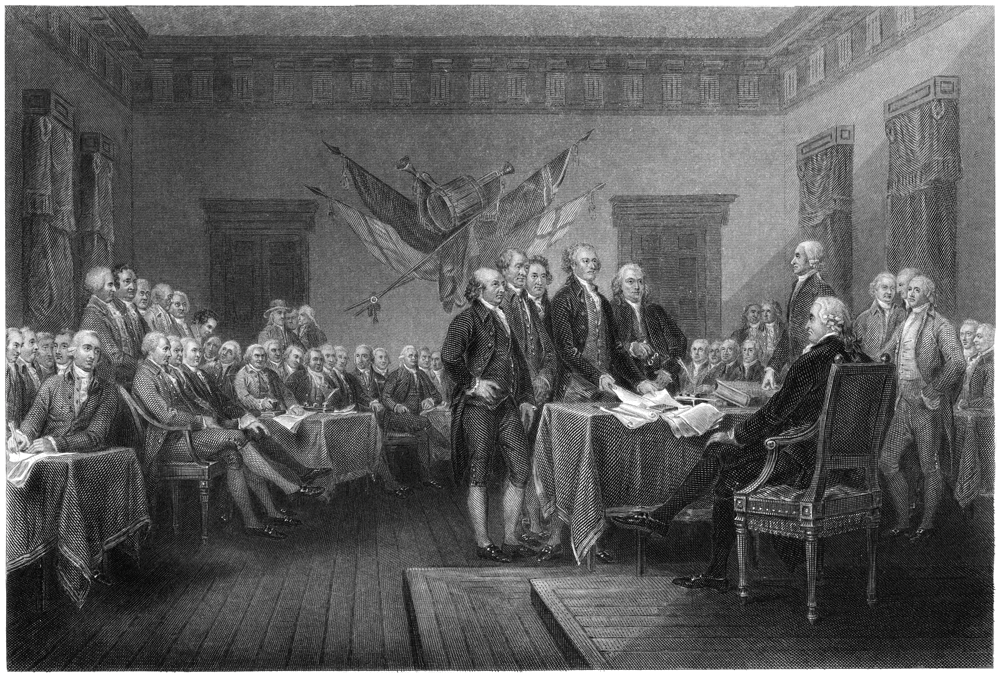
To bring about Independence, a written declaration was needed. The Continental Congress selected five men from five colonies to draft the Declaration of Independence, representing a totality of ideas. These men varied in more than just geographical location. The vast collection consisted of Thomas Jefferson of Virginia, whose eloquent writings included A Summary View of the Rights of British America in 1774; John Adams of Massachusetts, whose fiery oratory earned him the nickname the “atlas of Independence”; Benjamin Franklin of Pennsylvania, the great inventor and
polymath; Roger Sherman of Connecticut, the respected elder statesmen; and Robert Livingston of New York, the experienced lawyer.
In Pauline Maier’s work American Scripture: Making the Declaration of Independence, she rightly emphasizes that Thomas Jefferson was the draftsman, not the author. He penned the document, but he was assisted by the Committee of Five. In addition, the document was edited by the entire Continental Congress before it was signed. The writers of the Declaration articulated their reliance on the divine, the justification of independence based on concrete grievances, a unification of people and purpose, and a vision for the future.
The Declaration begins with the phrase, “When in the Course of human events, it becomes necessary for one people to dissolve the political bands which have connected them with another, and to assume among the powers of the earth, the separate and equal station to which the Laws of Nature and of Nature’s God entitle them, a decent respect to the opinions of mankind requires that they should declare the causes which impel them to the separation.”
The document gave form and meaning to the war against the British. The Declaration mentions the presence of God four times, twice at the beginning and twice at the end—almost like the four pillars of a building. According to the Declaration, we were created equal with rights by “Nature’s God” and by our “Creator.” Our nature is wholly dependent upon him. The Revolution itself is in the hands of “divine Providence.” Hence, the prose and poetry of this document embody this fourfold dependence on the one identified as the “Supreme Judge of the world.”
The divine was cited as the source of our rights, but the structure of the grievances was actually inspired by the English Bill of Rights of 1689, which was the result of the English Civil War. Thomas Jefferson took inspiration from the English Bill of Rights as he catalogued 27 grievances against the actions of the King of England:
“But when a long train of abuses and usurpations, pursuing invariably the same Object evinces a design to reduce them under absolute Despotism, it is their right, it is their duty, to throw off such Government, and to provide new Guards for their future security. . . The history of the present King of Great Britain is a history of repeated injuries and usurpations, all having in direct object the establishment of an absolute Tyranny over these States. To prove this, let Facts be submitted to a candid world.”
The 27 grievances are directed at King George with the phrase “He has.” The King is to blame, not the Parliament. These abuses were concrete and meaningful, and they were worth fighting against.
The grievances include reference to a mandate in 1773, where George III “made judges dependent on his Will alone, for the tenure of their offices, and the amount and payment of their salaries.” George III believed his mandate would make the judges loyal to the crown, but it was seen by colonists as a gross injustice. Another important grievance was against the Quartering Act of 1774, where colonists were required to host British soldiers in their home and to feed them. Incensed Colonists in Boston protested the Tea Act of 1773 by destroying over four tons of tea during the Boston Tea Party. In response to the Boston Tea Party, Great Britain revoked the charter of the Massachusetts Bay legislature. This was met with outrage in Virginia. As a result, the Virginia House of Burgesses formally objected, and they too had their legislative body dissolved by the Crown. The Declaration makes this clear when it says, “For suspending our own Legislatures, and declaring themselves invested with power to legislate for us in all cases whatsoever.”
One of the final grievances was a criticism that the King had hired foreign mercenaries for his war against the colonists. The king was willing to pay foreign Hessian soldiers instead of protecting his once-loyal British subjects. The 25th grievance states: “He is at this time transporting large Armies of foreign Mercenaries to compleat (sic) the works of death, desolation and tyranny.”
Even more interesting was that none of the grievances were assigned to a particular colony, thus creating the idea that to wrong a specific colony was to wrong the whole. The lack of a specific citation for which colony was wronged created a sense of fellowship. We often focus on the independence granted on July 4, but we often neglect the interdependence that was created. The official first lines of the Declaration are “The unanimous Declaration of the thirteen United States of America.” The colonies could not defeat the global superpower of Great Britain if even a single colony were to shrink back or defect in this time of crisis.
The American Revolution is in some ways an absurd notion: 13 disparate colonies facing off against a global empire. The 56 men who signed the document were committing treason against that superpower. Ben Franklin said soon after the Declaration was signed that, “We must, indeed, all hang together, or most assuredly we shall all hang separately.” The final lines of the Declaration double down on the commitment to unity: “And for the support of this Declaration, with a firm reliance on the protection of divine Providence, we mutually pledge to each other our Lives our Fortunes, and our sacred Honor.”
During the national birth, these colonies die from wounds or hardship caused by the war. As many as 17 of the signers would meet economic catastrophe during the war. The war itself would last over eight years. According to Historian Howard H. Peckham, as many as 25,000 Americans died for independence, along with thousands of wounded soldiers.1 Before the Declaration was signed, King George III had already outfitted over 400 ships filled with 32,000 troops to suppress American Liberty. The Continental Congress had ample justification for this revolution. But their spirits must have wavered as they saw these ships coming toward them.
In his book 1776, historian David McCullough writes: “At a stroke the Continental Congress had made the Glorious Cause of America more glorious still, for all the world to know, and also to give every soldier at this critical juncture something still larger and more compelling for which to fight.”2
The Declaration was read aloud in New York as 32,000 troops came to remind them that they were lowly subjects, to be subjected to the whims of their masters. General George Washington read it aloud to his troops: “The general hopes this important event will serve as fresh incentive to every officer and soldier to act with fidelity and courage, [the orders read] as knowing that now the peace and safety of his country depends (under God) solely on the success of our arms: And that he is now in the service of a state possessed of sufficient power to reward his merit, and advance him to the highest honors of a free country.”3
Those soldiers would have heard for the first time “That these United Colonies are, and of Right ought to be Free and Independent States; that they are Absolved from all Allegiance to the British Crown, and that all political connection between them and the State of Great Britain, is and ought to be totally dissolved.”
These words lived in the hearts and minds of the Patriots. They were with them in the snow of Valley Forge, at the Battle of Saratoga, and in prison cells and prison ships filled with dysentery. These self-evident truths help sustain those soldiers during an arduous yet victorious eight-year war.
The Declaration brought unity to the 13 colonies as they entered war. It also served as a vision for the nation they would soon build. It is a sort of mission statement: “We hold these truths to be self-evident, that all men are created equal, that they are endowed by their Creator with certain unalienable Rights, that among these are Life, Liberty, and the pursuit of Happiness.”
In our own times of polarization and division we often forget our own name: The United States of America. This is who we are—United. Our nation fought a bloody Civil War over that Union, “testing whether that nation or any nation so conceived can long endure.”4 Abraham Lincoln and Frederick Douglass, among many others, realized that the union of our nation is the guarantor of the freedoms of this nation. If we dissolve, we not only lose ourselves, but we lose the truths that we hold dear.
Observers will often note that slavery is not addressed in the Declaration. Civil War expert Allen Guelzo points out that there are “discrepancies between the spirit of the Declaration and the practices (slavery) sanctioned by the Constitution, this was only the discrepancy one had to expect between aspiration and reality.”5
Our highest hopes do not always match the realities of life. Lincoln, among many others, saw the Declaration as the aspiration of a people. When we are confronted with the injustice of slavery in American history, we must recognize it as a violation of our highest aims, the truth of human equality before our Creator. Slavery is incongruous with the ideals of the Declaration, and it is precisely that conflict between aspiration and reality that has shaped our nation.
Allen Guelzo emphasizes that America is unique because it “was founded not on shared bloodlines, ethnicity, or ancient ancestry, but on a proposition.”6 Lincoln saw the Civil War as a time of new birth for a nation that was “conceived in Liberty, and dedicated to the proposition that all men are created equal.”7
In many ways a throughline exists between Jefferson’s words in the Declaration of Independence, Lincoln’s Gettysburg Address, and Dr. Martin Luther King’s “I have a dream.” They remind us that America was conceived in the ideal aspiration of human equality, and it will never be a finished work. Such equality must be constantly pursued, attained, maintained, and regained.
These truths transcend time and space. These ideals did not belong solely to Jefferson and the Founding Fathers. They became the ideals of every colony who sent delegates; of every colony who sent soldiers into battle; of every woman who served as a field nurse; of every black man, slave or free, who supported the cause of liberty. It was the birthright of their children and their children’s children “that they are endowed by their Creator with certain unalienable Rights, that among these are Life, Liberty, and the pursuit of Happiness.” That ideal, that fire, burns as the soul of this nation. Each citizen, born or naturalized, becomes part of that body dedicated to the pursuit of that unfinished work.