Recently, I sat down with my preteen daughters to watch the trailer for the newest Toy Story installment. The footage opens with Bonnie, the toys’ owner, receiving a mysterious package. When she opens it, out pops Lilypad, a shiny, frog-shaped smart tablet that immediately commands her undivided attention.
Visibly shaken, the classic gang watches from the shadows. This new device is not just a new playmate. It is a competitor for Bonnie’s affection. The existential dread is captured perfectly by Rex, the neurotic dinosaur, who whimpers, “Extinction! Not again.”
While, at the time of my writing this, the full plot remains under wraps, the thematic trajectory is clear. Woody, Buzz, and the gang are confronting what it means to be relevant in a digital age. It is a continuation of the series’ most profound questions: Who am I if my role changes? Where do I belong? What does faithfulness look like when the world shifts beneath my feet?
As an educator, I find it easy to sympathize with Rex. Across the landscape of modern academia, a similar Lilypad has arrived in the form of Generative AI. Like Bonnie’s toys, we are left wondering if our traditional models of formation, presence, and embodied learning are about to be tossed into the collection bin of history.
The Technological Imperative
We see even Christian institutions rushing to integrate generative AI into every facet of campus life, from document summarization to student life operations, all under the banner of preparing students for a rapidly changing world. There is, however, scant evidence of generalized learning gains resulting from AI and LLMs (Large Language Models). The current data is insufficient to support the mass integration of AI into learning. Claims that AI integration into the academic ecosystem will result in overall improvements in learning are at best premature, and more likely delusional. Furthermore, while calls for AI literacy in higher education are common, they may overstate the value of technical instruction. Most AI applications are designed for ease of use, and the speed at which these tools change means that any basic platform-specific knowledge acquired in college may have a very short shelf life. My observation is that many rushing to implement AI in the classroom are not driven by pedagogical motivations. Rather, we are experiencing the “technological imperative” in real time. This is the belief that if a technology exists, it must be adopted, regardless of cost, necessity, or consequence.
This is not my first time seeing this reaction of fear to a perceived existential threat. Years ago, I served as an administrator at a small, traditional Christian school near Philadelphia. When I arrived, the school was reeling from a top-down initiative to go 1:1, meaning the school would assign every student a personal electronic device.
The initiative was not requested by teachers, parents, or students. In fact, many were resistant. This change was not born out of a pedagogical conviction that screens would foster deeper spiritual maturation or more creative thinking. Instead, it was a reaction to the inevitability of the future. It was a move made in the shadow of Rex’s fear: Adapt or go extinct.
Much of this push was in the name of “technology literacy.” But kids don’t need to learn how to use tablets. These personal devices, much like common AI platforms, are designed to be intuitive. Tablets and smartphones are built so children can navigate them easily and so they capture and hold their attention. Most young children already know how to use smart devices better than their parents or teachers. Indeed, what they need to be taught is how not to use them.
Thankfully, at that institution, calmer heads eventually prevailed. The school returned to its roots, choosing to use technology only when it was pedagogically warranted. Today, as we face the AI revolution, we must ask if resistance is futile. Is our only choice to join the digital hive mind or die? Is there a better way, a different path rooted in the Imago Dei and the reality of how humans actually learn and flourish?
From Information to Authenticity
It has been said that we have been living in an age where information has been the most valuable resource of our lives. But perhaps we should consider our new reality from a different perspective. With the rise of AI, where information is available to everyone at a few keystrokes, information will become increasingly less valuable. Instead, we should recognize how we are entering an era where it is authenticity that increases in value as it becomes increasingly rare.
We can also anticipate that students will increasingly seek out the genuine, the authentic, the meaningful, and the purposeful. Mission-driven Christian colleges and Christians, in general, are being handed a new opportunity to present a purposeful and genuine vision of life as it truly is. It is a vision that embraces our humanity instead of attempting to escape it. While the futurist and the transhumanist vision attempts to reimagine what it means to be human, this imagining must be recognized for what it is: a futile attempt to escape reality. Christianity, in contrast, offers a vision of the truly transcendent, and this vision begins with the incarnate.
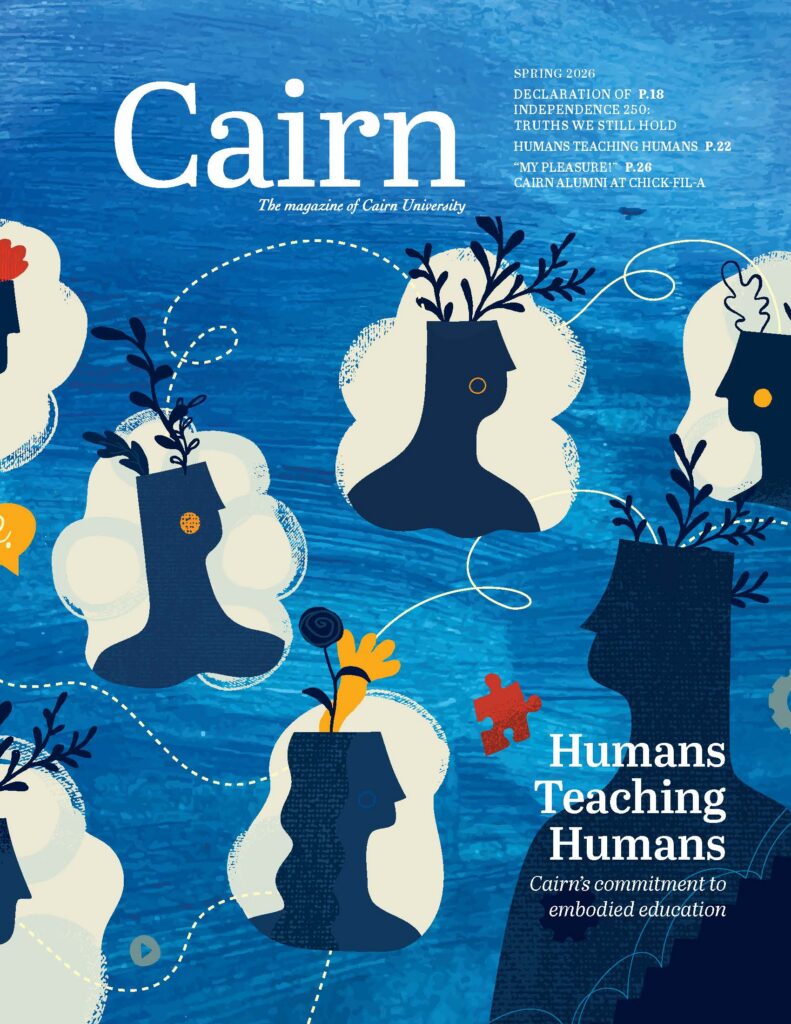
As Christians, we believe that humans are not brains on sticks, i.e., data processing units. Learning is holistic. It is shaped by our bodies, our senses, and our physical proximity to others. A digital surrogate cannot replace the formative power of a face-to-face encounter. In addition, humans, made in God’s image, are valuative analysts. We interpret all our experiences. To do so rightly, we must view through the filter of godly wisdom, not through the distorted filter of the “enhanced” human collective. At its core, the most profound education is a matter of humans teaching humans. When we surrender the classroom to the technological imperative, we risk trading the gold of human formation for the shiny plastic of digital efficiency.
Wisdom vs. Technical Skill
The rush to adopt AI often conflates knowledge or data retrieval with wisdom. In the biblical tradition, wisdom is far more than technical skill or the ability to summarize a document. It is the skill of living rightly in the fear of the Lord. For a Christian university, this means we must evaluate technology not on the basis of novelty but on whether it nurtures or undermines human flourishing as God defines it. If a tool makes a student more productive but less attentive, is it a win? If it makes research easier but eliminates the struggle and friction required to develop critical discernment, have we actually educated?
Commitment to biblical wisdom means that all of life is lived coram Deo, before the face of God. This means even our classroom tools must be weighed against their impact on the heart. Technology is never neutral. It always nudges us in a direction. It is always teaching us how to be human. If our tools teach us that speed is better than meditation, or that a generated answer is better than a hard-won insight, they are teaching us to be less like humans and more like machines.
The Creation Mandate and the Subjugation of Tech
A biblical approach to AI is not a wholesale rejection of the technology. Rather, it is an approach that puts technology in its proper place. In Genesis 1:28, God gives humanity the Creation Mandate, which is the call to subdue the earth and have dominion over it. This mandate suggests that we are to be masters of our tools, not servants to them. A faithful approach to Generative AI is one that subjugates the technology rather than surrendering to it.
We see our humanity not as a problem to be overcome or an inconvenience to be bypassed but as a gift from God to be treasured. We believe in the Incarnation, the world-shattering truth that God became flesh. This validates the physical world, the physical body, and the physical classroom.
In an age of AI, the most radical thing a Christian university can offer is an incarnational model of learning. We can offer a community where the person is primary and where we protect the sacred space of humans teaching humans. This is not merely a preference for physical proximity or the convenience of being in the same room; rather, it is a recognition that true education is a form of soulcraft. It is a recognition of the fact that all truth and all good is relational. It is an acknowledgment that discipleship requires the deep, spiritual friction of one image-bearer sharpening another. Christian education is a kind of transmission of power, the transmission of a wisdom that can only be forged through the relational labor of shaping souls, not just the efficiency of processing data.
The Living Alternative
Mission-driven Christian colleges have a unique opportunity to present a living alternative to the technological imperative. We can lean into the Christian doctrine of creation, the mystery of the Incarnation, the promise of the resurrection of the body, and the assurance of the life to come. These make up the bedrock of a philosophy of education. They remind us that the physical world matters, that relationships are the primary crucible of growth, and that the life to come involves a restored physical reality, not a digital nirvana.
In the Toy Story trailer, the toys are afraid of being replaced. But as any child who has truly loved a toy knows, a shiny tablet can never replace the realness of a companion that has been through the mud and the tea parties.
Similarly, AI may be able to write a paper, but it cannot sit across from a struggling student and offer the Word in season that changes a life. It cannot model the fruit of the Spirit. It cannot fear the Lord. It cannot approach education as discipleship. As we move forward, let us use our tools with intentionality, ensuring they serve the ends of human formation. Let us choose the embodied over the encoded, and the authentic over the artificial.